Table of Contents
Table of Contents
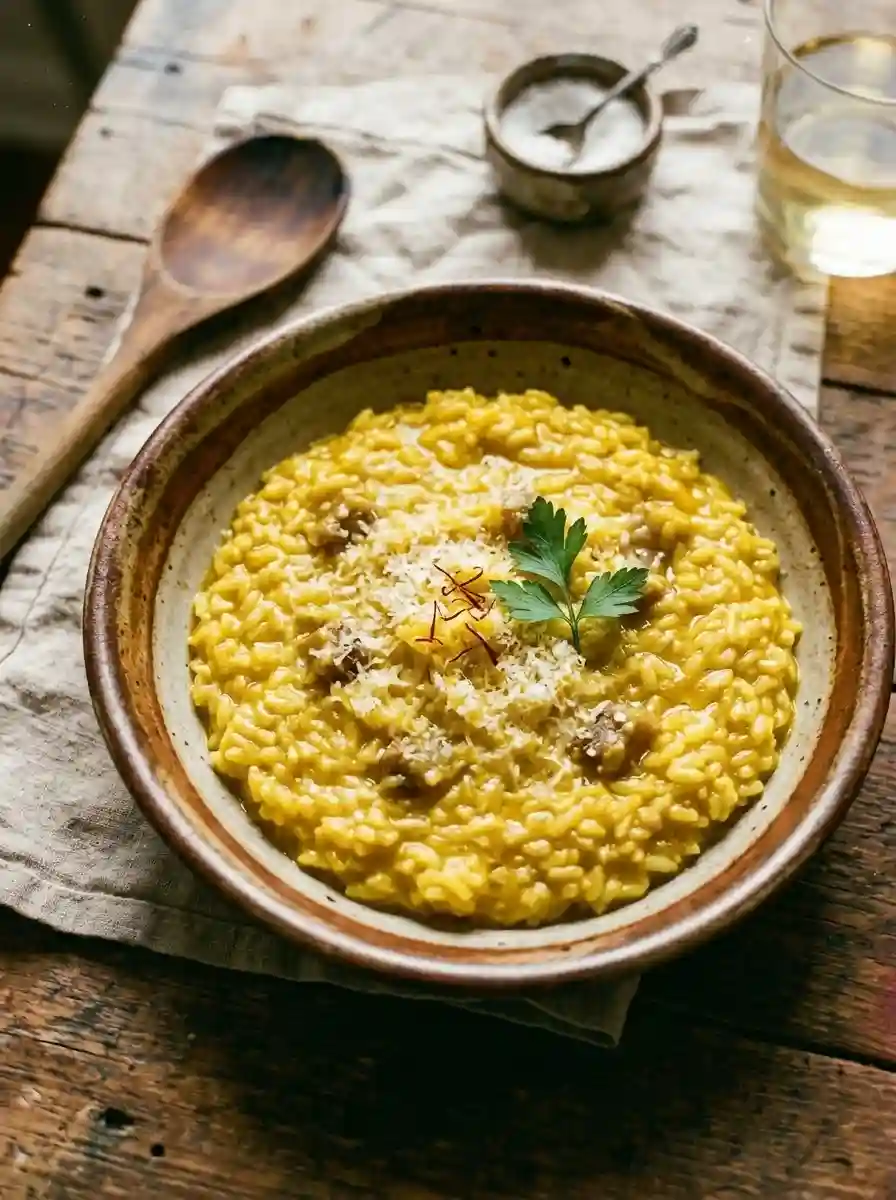
Risotto alla Milanese is the crown jewel of Northern Italian cuisine. Known for its luxurious, velvety texture and vibrant golden hue, this classic dish transforms simple pantry staples into an elegant, restaurant-quality meal. Legend says it was created in 1574 by a stained-glass apprentice in Milan who added saffron to a wedding risotto to mimic the golden domes of the Duomo. Today, it remains the ultimate comfort food with a touch of sophistication.
Note: Total active time is about 25 minutes. The secret to perfect risotto is patience, hot broth, and constant attention.
Dietary Badges
- Naturally Gluten-Free
- Vegetarian Option (Use vegetable or chicken broth)
- One-Pot Meal
- Authentic Italian Technique
The 3 Biggest Mistakes People Make with Risotto
Even experienced cooks can ruin a risotto by falling into these common traps. Avoid these to guarantee a creamy, al dente masterpiece every time:
- Washing the Rice (The Starch Killer): Never rinse Arborio or Carnaroli rice! The surface starch (amylopectin) is exactly what creates the creamy, velvety sauce. Washing it away will result in a soupy, flavorless dish.
- Using Cold Broth (The Temperature Shock): Adding cold stock to the pan drops the cooking temperature, shocking the rice and causing it to cook unevenly. Always keep your broth in a separate pot at a gentle simmer right next to your risotto pan.
- Overcooking or Over-stirring (The Glue Trap): While you need to stir frequently to release the starch, aggressive, non-stop stirring can break the rice grains and make the dish gluey. Stir gently and rhythmically, and remove the pan from the heat 1-2 minutes before the rice is perfectly al dente. The residual heat will finish the cooking (carryover cooking).

Why This Works: The Science of Perfect Risotto
- The Toasting Phase (Tostatura): Sautéing the dry rice in fat (butter/oil) before adding liquid seals the outer layer of the grain. This allows it to absorb the broth slowly without turning into mush, while maintaining a firm, al dente core. ,
- The Saffron Infusion: Saffron’s flavor compounds are fat-soluble and alcohol-soluble. Dissolving the threads in warm broth (or a splash of wine) before adding them ensures maximum extraction of its iconic golden color and complex, floral aroma.
- The Mantecatura (The Magic Finish): This is the most crucial step in Italian risotto making. By removing the pan from the heat and vigorously stirring in cold butter and grated Parmesan, you create a stable emulsion. The fat binds with the released starch, transforming the dish from “rice in broth” to a glossy, unified, creamy sauce.
Ingredients
Measurements are provided in both US Customary and Metric for precision. Your exact ingredients are kept intact, with precise quantities added for perfect results.
The Base:
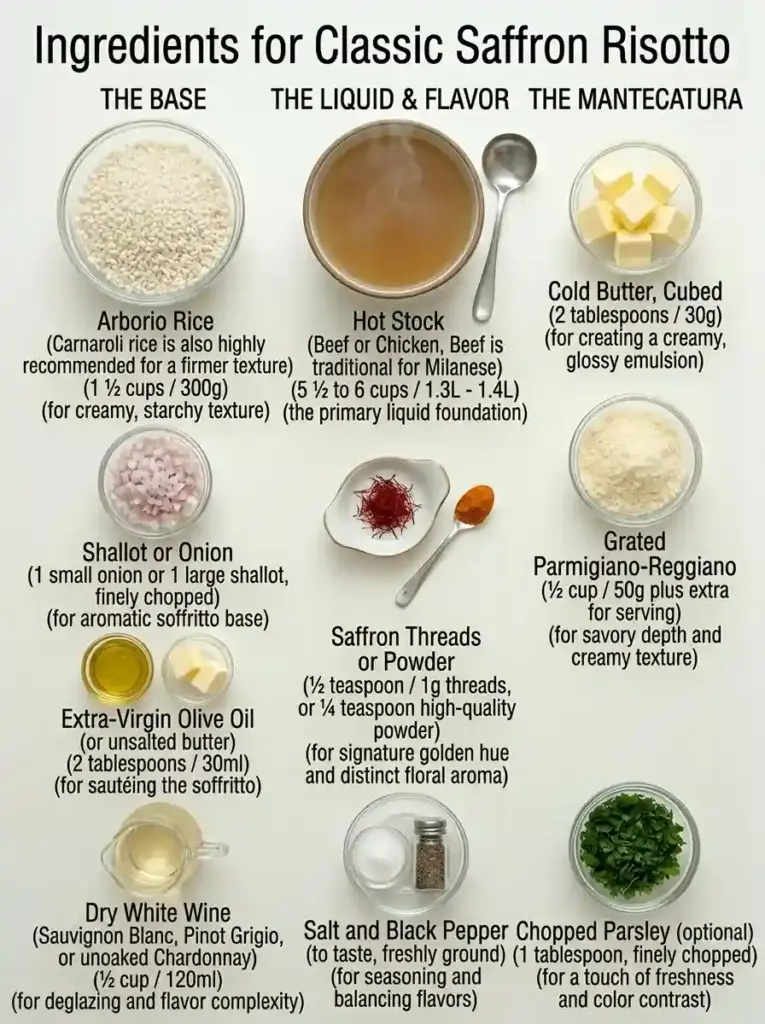
- 1 ½ cups (300g) Arborio rice (Carnaroli rice is also highly recommended for a firmer texture)
- 1 small onion or 1 large shallot, finely chopped
- 2 tablespoons (30ml) extra-virgin olive oil or unsalted butter (for the soffritto)
- ½ cup (120ml) dry white wine (Sauvignon Blanc, Pinot Grigio, or unoaked Chardonnay)
The Liquid & Flavor:
- 5 ½ to 6 cups (1.3L – 1.4L) beef or chicken stock (Beef stock is the traditional Milanese choice, especially if serving with Osso Buco. Keep it hot!)
- ½ teaspoon (1g) saffron threads (or ¼ teaspoon high-quality saffron powder)
- Salt and freshly ground black pepper, to taste
The Mantecatura (Finishing Touches):
- 2 tablespoons (30g) cold unsalted butter, cubed
- ½ cup (50g) freshly grated Parmigiano-Reggiano cheese (plus extra for serving)
- 1 tablespoon fresh flat-leaf parsley, finely chopped (optional, for freshness)
Step-by-Step Instructions
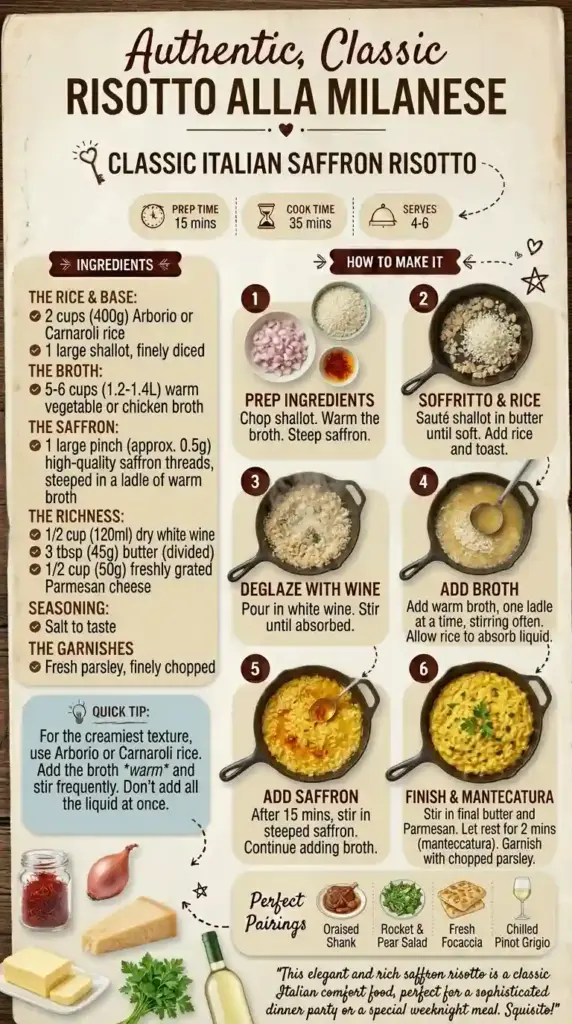
1. Prep Your Station (Crucial for Success)
Risotto is a hands-on dish. Have your broth simmering in a pot right next to your risotto pan. Measure out your wine, butter, and cheese so you aren’t scrambling while the rice cooks.
2. Infuse the Saffron
In a small bowl or measuring cup, combine the saffron threads with 2 tablespoons of the hot simmering broth. Crush the threads gently with the back of a spoon and set aside to let the color and flavor bloom.
3. Build the Soffritto and Toast the Rice
In a heavy-bottomed saucepan or Dutch oven, heat the olive oil (or 1 tbsp butter) over medium heat. Add the finely chopped onion/shallot and a pinch of salt. Sauté gently for 3-4 minutes until soft and translucent (do not let it brown). Add the Arborio rice and toast it, stirring constantly, for 2-3 minutes. The grains should become translucent around the edges and smell slightly nutty.
4. Deglaze with Wine
Pour in the dry white wine. Turn the heat up to medium-high and stir until the wine is completely absorbed and the alcohol smell has cooked off (about 1-2 minutes).
5. The Gradual Broth Method
Reduce the heat to a gentle simmer. Add 1 cup (240ml) of the hot broth to the rice. Stir gently until the liquid is almost completely absorbed. From this point on, add the remaining hot broth ½ cup (120ml) at a time, waiting until each addition is nearly absorbed before adding the next. Stir frequently, but not frantically. This process will take about 18-20 minutes.
6. Add the Saffron
About 5 minutes before the rice is done (when it is tender but still has a slight firm bite in the center), stir in the saffron and its soaking broth. Watch the risotto transform into a brilliant golden color.
7. The Mantecatura (Off the Heat!)
Turn off the heat. This is non-negotiable. Remove the pan from the burner. Add the cold cubed butter, the grated Parmigiano-Reggiano, and the chopped parsley. Stir vigorously for 1-2 minutes until the risotto becomes glossy, creamy, and slightly fluid (it should ripple like a wave when you shake the pan, a technique Italians call all’onda). Taste and adjust salt and pepper if needed.
8. Rest and Serve
Cover the pan and let it rest for 2 minutes. This allows the flavors to marry and the texture to perfect itself. Serve immediately in warm bowls, topped with extra Parmigiano-Reggiano.
Pro-Tips for Next-Level Risotto
- Rice Variety Matters: Arborio is the most common and widely available. Carnaroli is considered the “king of risotto rice” because it has a higher starch content and holds its al dente shape better. Vialone Nano is a third excellent, slightly smaller-grained option.
- The Authentic Upgrade: For a truly traditional Milanese experience, render 1-2 tablespoons of beef marrow with the butter and onions in Step 3. Remove the solid marrow before toasting the rice, leaving behind its rich, savory fat.
- Don’t Trust the Clock, Trust Your Taste: The “20-minute” rule is a guideline. Your stove’s heat and the rice brand will vary. Start tasting at minute 17. The rice should be tender but offer a slight resistance in the very center.
- Leftover Hack (Arancini): Risotto is best eaten immediately. If you have leftovers, chill them completely, roll them into balls with a cube of mozzarella in the center, bread them, and fry them to make incredible Arancini (Italian rice balls).
Troubleshooting Table
| Problem | Cause & Solution |
|---|---|
| Risotto is too soupy/watery | Cause: Added too much broth too quickly, or didn’t let it absorb. Solution: Turn heat to medium and stir vigorously for 1-2 minutes to evaporate excess liquid and release more starch. |
| Rice is still hard/crunchy | Cause: Heat was too low, or broth was added too slowly. Solution: Add another ½ cup of boiling broth, turn heat up slightly, and continue cooking, tasting every 2 minutes. |
| Risotto is gluey or sticky | Cause: Over-stirred, overcooked, or the wrong type of rice was used. Solution: Unfortunately, this can’t be fully fixed. Next time, stir gently and pull it off the heat while still slightly al dente. |
| Color is pale, not golden | Cause: Saffron was old, or not enough was used. Solution: Ensure you are using high-quality saffron threads. Bloom them in hot liquid for at least 5 minutes before adding. |
Storage & Reheating
- Refrigerator: Risotto is best fresh, but leftovers can be stored in an airtight container for up to 2 days. It will solidify in the fridge (this is normal).
- Reheating: Do not microwave, as it will become rubbery. Reheat gently in a saucepan over low heat, adding 2-3 tablespoons of hot broth or water and stirring constantly until it regains its creamy texture.
- Freezing: Not recommended for plain risotto, as the texture will become grainy. However, as mentioned above, it is excellent for making Arancini, which freeze beautifully before frying.

Frequently Asked Questions
Can I make Risotto alla Milanese ahead of time?
Risotto is best served immediately for the perfect creamy texture. However, you can prepare the soffritto (onions) and keep the broth simmering ahead of time. If you have leftover cooked risotto, don’t reheat it as a creamy dish; instead, chill it completely and use it to make delicious fried Arancini (Italian rice balls).
What is the best rice to use for this recipe?
Carnaroli is considered the “king of risotto rice” because it holds its shape beautifully while releasing starch for a creamy texture. Arborio is the most common and widely available, and works perfectly. Vialone Nano is another excellent, slightly smaller-grained alternative traditionally used in Northern Italy.
Can I use saffron powder instead of saffron threads?
Yes, you can. Use about ¼ teaspoon of high-quality saffron powder in place of ½ teaspoon of threads. However, threads are highly recommended for authentic Risotto alla Milanese, as they provide a more complex, floral aroma and a more vibrant, natural golden color when bloomed in hot liquid.
What wine should I use for cooking and serving?
For cooking: Use a dry, crisp white wine with good acidity, such as Pinot Grigio, Sauvignon Blanc, or an unoaked Chardonnay. For serving: A light-to-medium-bodied Italian red wine like Barbera, Dolcetto, or a young Nebbiolo pairs beautifully with the richness of the saffron and Parmesan. A rich white like oaked Chardonnay also works well.
Why is my risotto gluey or sticky?
This usually happens for three reasons: 1) Over-stirring, which breaks the rice grains and releases too much starch too quickly. 2) Overcooking the rice past the al dente stage. 3) Not toasting the rice in fat before adding liquid. Stir gently and rhythmically, and remove from heat just before it reaches your desired doneness.
Can I make this recipe vegetarian?
Absolutely! While traditional Milanese risotto uses beef stock (especially when served with Osso Buco), you can easily substitute it with a high-quality, robust vegetable broth or mushroom broth. The saffron, butter, and Parmesan will still create a deeply flavorful and luxurious dish.
How do I properly reheat leftover risotto?
Avoid the microwave, as it will make the rice rubbery and dry. Instead, reheat it gently in a saucepan over low heat. Add 2-3 tablespoons of hot broth or water and stir constantly until the risotto loosens up and regains its creamy, glossy texture.
What is the “mantecatura” and why is it important?
Mantecatura is the crucial final step in Italian risotto making. It involves removing the pan from the heat and vigorously stirring in cold, cubed butter and freshly grated Parmigiano-Reggiano. This creates a stable emulsion with the rice starch, transforming the dish from “rice in broth” to a unified, glossy, and creamy sauce.
Can I freeze Risotto alla Milanese?
Freezing plain, creamy risotto is not recommended, as the texture becomes grainy and the emulsion breaks upon thawing. However, leftover risotto is the perfect base for making Arancini (fried rice balls), which can be shaped, breaded, and frozen beautifully before frying.
What should I serve with Risotto alla Milanese?
Traditionally, it is served as a side dish (contorno) alongside Osso Buco (braised veal shanks). It also pairs wonderfully with braised short ribs, pork chops Milanese, or roasted chicken. In Italy, it can also be served on its own as a rich first course (primo piatto).

Authentic Risotto alla Milanese (Creamy, Saffron-Infused Italian Classic)
- Total Time: 35 mins
- Yield: 4 servings 1x
Description
Creamy golden risotto alla Milanese, infused with saffron and finished with Parmigiano-Reggiano. The classic Northern Italian dish with its signature vibrant color and rich flavor.
Ingredients
- 1 ½ cups Arborio rice
- 4 cups chicken or beef broth, heated
- 1 small onion, finely chopped
- ½ cup dry white wine
- 1 pinch saffron threads
- 3 tbsp butter
- ½ cup grated Parmesan cheese
- Salt and pepper to taste
Instructions
- Bloom saffron: Steep saffron in 2 tbsp hot stock; set aside.
- Soffritto: Melt 2 tbsp butter with oil over medium. Cook onion until translucent (5 mins).
- Toast rice: Add rice; stir 2-3 mins until edges become translucent.
- Deglaze: Pour in wine; stir until absorbed.
- Cook: Add hot stock 1/2 cup at a time, stirring constantly until absorbed before adding more (18-20 mins total).
- Finish: When rice is al dente, stir in saffron mixture, remaining butter, Parmesan, and cream (if using). Season.
- Rest: Cover 2 mins before serving (risotto should flow like lava).
Notes
- Authentic touch: Use beef stock for deeper flavor (traditional in Milan).
- Saffron quality: Spanish or Iranian saffron preferred for color.
- Don’ts: Never rinse rice; avoid pre-toasted ‘risotto’ rice.
- Leftovers make excellent arancini (risotto balls).
- Prep Time: 10 mins
- Cook Time: 25 mins
- Category: Main Course
- Method: Stovetop
- Cuisine: Italian (Lombard)
Nutrition
- Serving Size: 1 cup
- Calories: 480
- Sugar: undefined
- Sodium: 800mg
- Fat: 18g
- Saturated Fat: 9g
- Unsaturated Fat: undefined
- Trans Fat: undefined
- Carbohydrates: undefined
- Fiber: 2g
- Protein: 12g
- Cholesterol: undefined
🥗 Free Custom Keto Meal Plan?
Do you want to lose weight while still enjoying delicious Asian & Thai Fusion meals? Take this quick quiz to get your personalized Keto plan based on your favorite foods!
- ✅ No more guessing what to eat
- ✅ Delicious & easy-to-make recipes
- ✅ Tailored to your body type
Get My Custom Plan Now! →
*Over 100,000+ people have transformed their lives with this quiz.