Table of Contents
Table of Contents
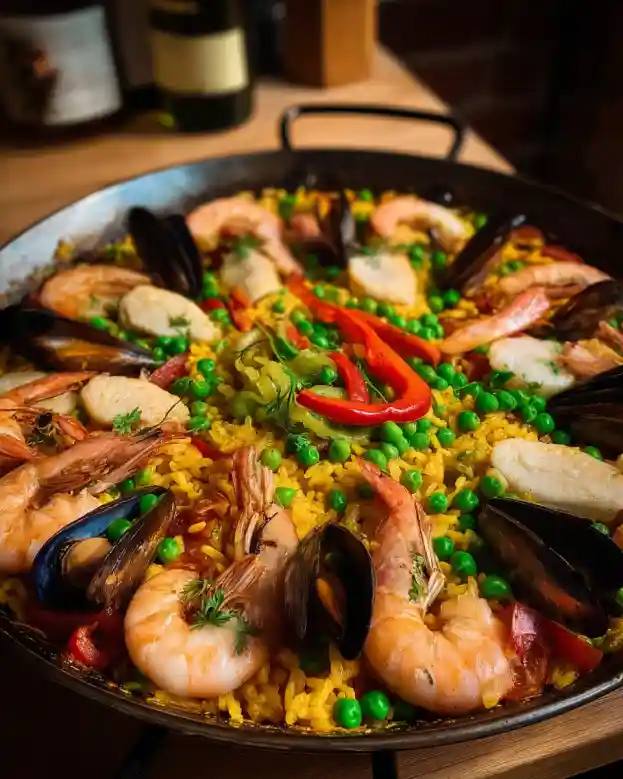
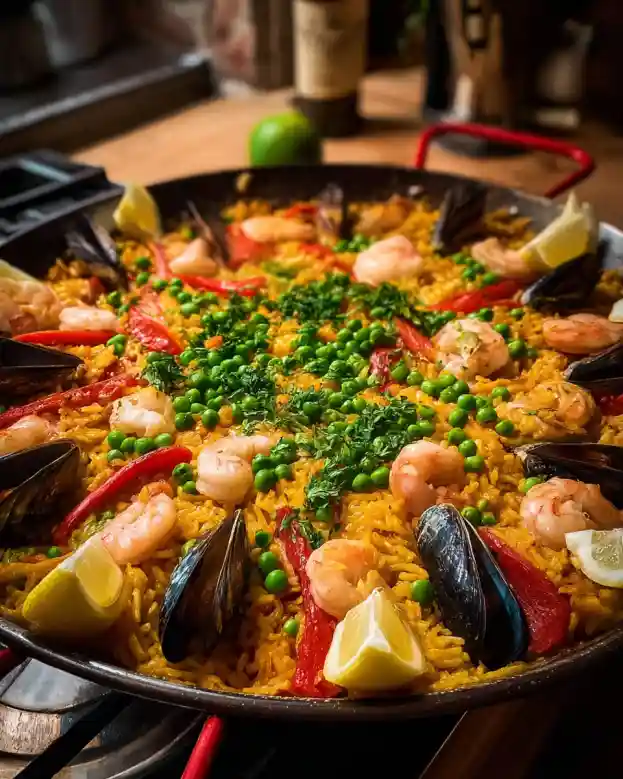
Dreaming of transporting your taste buds to Spain without leaving your kitchen? This Easy Spanish Paella Recipe delivers the vibrant, saffron-infused magic of traditional Spanish cuisine right on your stovetop—using just a regular skillet, no fancy paella pan required.
Imagine the intoxicating aroma of saffron blooming in warm broth, the satisfying sizzle of chicken and seafood, and that coveted socarrat (the crispy, caramelized rice crust at the bottom that Spaniards fight over). This recipe combines tender chicken, plump shrimp, perfectly opened mussels, and rice that absorbs every drop of flavor—without becoming mushy or overcooked.
Unlike recipes that leave you with undercooked rice or rubbery seafood, this method uses science-backed techniques (proper rice-to-liquid ratio, seafood timing, and the authentic towel-resting method) to guarantee restaurant-quality results every time.
🏷️ Dietary Badges: Gluten-Free • Dairy-Free-Option • High-Protein • One-Pot Meal • Crowd-Pleaser
Why You’ll Love This Spanish Paella Recipe
| Benefit | Why It Matters |
|---|---|
| 🌍 Authentic Spanish flavors | Saffron, smoked paprika, and proper technique = real deal |
| 🍳 One pan, minimal cleanup | No colander, no extra pots—everything in one skillet |
| 🦐 Perfectly cooked seafood | Shrimp stays tender, mussels open perfectly, no rubbery texture |
| 🍚 Socarrat guaranteed | That crispy bottom layer everyone fights over |
| 🥘 No paella pan needed | A 12″ skillet works perfectly (with depth guidance) |
| 🔄 Endlessly customizable | Swap proteins, add veggies, make it your own |
| 🎉 Crowd-pleaser | Feeds 4-6 people, perfect for dinner parties |
| 📦 Meal-prep friendly | Stores well, reheats beautifully |
Ingredients (Dual Measurements + Scalable)
Base Recipe (Serves 4-6)
| Ingredient | US Measure | Metric | Notes |
|---|---|---|---|
| Extra virgin olive oil | 3 tbsp | 45 ml | Spanish olive oil if available |
| Boneless chicken thighs, cut into 1-inch pieces | 1 lb | 450 g | Thighs stay juicier than breasts |
| Jumbo shrimp, peeled & deveined | ½ lb | 225 g | Tail-on for flavor, 16-20 count |
| Mussels, cleaned & debearded | ½ lb | 225 g | Fresh = must smell like ocean |
| Bomba rice (or Calasparra/Valencia) | 1½ cups | 300 g | NOT Arborio – see why below |
| Chicken broth (low-sodium) | 3 cups | 720 ml | Warm, not cold |
| Saffron threads | ½ tsp | 1 g | Bloom in warm broth (see Step 1) |
| Smoked paprika (pimentón) | 1 tsp | 2 g | Sweet or bittersweet, not hot |
| Cayenne pepper | ¼ tsp | 0.5 g | Optional, adjust to taste |
| Yellow onion, finely diced | 1 medium | 150 g | About 1 cup diced |
| Garlic cloves, minced | 4 cloves | 4 cloves | Fresh = best flavor |
| Red bell pepper, diced | 1 large | 150 g | Adds sweetness + color |
| Roma tomatoes, diced | 3 medium | 300 g | Or 1 cup canned crushed tomatoes |
| Bay leaf | 1 leaf | 1 leaf | Removes before serving |
| Dry white wine | ¼ cup | 60 ml | Sauvignon Blanc or Pinot Grigio |
| Frozen peas | ½ cup | 75 g | Adds color + sweetness |
| Fresh parsley, chopped | ¼ cup | 15 g | For garnish |
| Lemon wedges | 2 lemons | 2 lemons | Essential for serving |
| Salt & freshly ground black pepper | To taste | To taste | Start light, adjust at end |
💡 Critical Note on Rice: Do NOT use Arborio rice (that’s for risotto and creates a creamy texture). Use Bomba, Calasparra, or Valencia rice—these short-grain varieties absorb 3x their volume in liquid without becoming mushy. If unavailable, substitute with Calrose (medium-grain) rice and reduce broth to 2¾ cups.
Scaling Notes
| Servings | Rice | Broth | Chicken | Seafood |
|---|---|---|---|---|
| 2-3 (Half) | ¾ cup (150 g) | 1½ cups (360 ml) | 8 oz (225 g) | ¼ lb each shrimp + mussels |
| 4-6 (Standard) | 1½ cups (300 g) | 3 cups (720 ml) | 1 lb (450 g) | ½ lb each shrimp + mussels |
| 8-10 (Double) | 3 cups (600 g) | 6 cups (1.4 L) | 2 lb (900 g) | 1 lb each shrimp + mussels |
⚠️ Important: For double batch, use a 14″+ skillet or paella pan. Rice layer should never exceed 2 cm (¾ inch) depth for even cooking.

Key Ingredients & The Science Behind Them
Rice: Why Bomba Beats Arborio
| Rice Type | Absorption | Texture | Verdict |
|---|---|---|---|
| Bomba/Calasparra | 3x liquid | Separate, firm grains | ✅ Perfect for paella |
| Arborio | 2x liquid | Creamy, sticky | ❌ Wrong – makes risotto |
| Calrose (medium-grain) | 2.5x liquid | Slightly sticky | ⚠️ Acceptable substitute |
| Long-grain (Basmati/Jasmine) | 1.5x liquid | Too firm/dry | ❌ Avoid |
Saffron: The Golden Spice
Saffron is the most expensive spice in the world (by weight, more than gold!). It provides:
- Color: Golden-yellow hue
- Flavor: Subtle, floral, slightly honey-like
- Aroma: Distinctive, warm
Budget Alternative: If saffron is unavailable, use ¼ tsp turmeric + pinch of paprika for color (but flavor will differ).
Chicken Thighs vs. Breasts
Always use thighs for paella because:
- Higher fat content = stays juicy during long cooking
- More flavorful than lean breasts
- Forgiving if slightly overcooked
Seafood Timing is Everything
- Shrimp: Cooks in 3-4 minutes (turns pink + opaque)
- Mussels: Cook in 5-7 minutes (shells open = done)
- Calamari: Cooks in 45 seconds OR 45+ minutes (anything in between = rubbery)
Key Insight: Seafood releases liquid as it cooks (mussels release ~½ cup!). This “free seafood stock” adds incredible flavor to the rice.
Prep Tips (Set Yourself Up for Success)
- Bloom the saffron (Step 1 below) – This is CRITICAL for maximum flavor
- Warm the broth – Cold broth shocks the rice = uneven cooking
- Clean mussels properly – Remove “beards,” discard any that don’t close when tapped
- Pat chicken dry – Ensures proper browning, not steaming
- Measure everything before starting – Paella moves fast once cooking begins
- Use the right pan – 12″ skillet minimum, rice layer max 2cm deep
- Have a tight-fitting lid ready – For resting step (or use foil + kitchen towel)
Step-by-Step Spanish Paella Instructions
Time Breakdown
- Prep: 20 minutes (includes saffron blooming)
- Cook: 35-40 minutes
- Rest: 10 minutes
- Total: ~65-70 minutes
Step 1: Bloom the Saffron (5 min)
- In a small bowl, combine ½ tsp saffron threads with ¼ cup warm chicken broth (not boiling).
- Let steep for 5 minutes while you prep other ingredients.
- The broth will turn deep golden-orange.
💡 Why Bloom Saffron? Heat releases saffron’s flavor compounds (crocin for color, picrocrocin for taste, safranal for aroma). Blooming in warm liquid maximizes extraction.
Step 2: Sear the Chicken (5-7 min)
- Heat 2 tbsp olive oil in a 12″ skillet over medium-high heat.
- Pat chicken pieces dry, season with salt and pepper.
- Add chicken in a single layer (don’t overcrowd—work in batches if needed).
- Sear 3-4 minutes per side until golden-brown (doesn’t need to be cooked through).
- Remove chicken to a plate and set aside.
Why Sear First? Maillard reaction creates complex flavors. If you add raw chicken directly to rice, it steams instead of browning = bland flavor.
Step 3: Build the Flavor Base (Sofrito) (8-10 min)
- Reduce heat to medium. Add remaining 1 tbsp olive oil if pan is dry.
- Add diced onion, cook 3-4 minutes until translucent.
- Add garlic and bell pepper, cook 2 minutes until fragrant.
- Add diced tomatoes, 1 tsp smoked paprika, ¼ tsp cayenne, and 1 bay leaf.
- Cook 3-4 minutes, stirring occasionally, until tomatoes break down and mixture thickens.
💡 This is your “sofrito”—the flavor foundation of Spanish cooking. Take time here; don’t rush.
Step 4: Toast the Rice (2 min)
- Add 1½ cups Bomba rice to the skillet.
- Stir constantly for 2 minutes until rice is coated in oil and smells nutty.
- Pour in ¼ cup white wine, stir to deglaze, cook 1 minute until wine evaporates.
Why Toast Rice? This seals the outer layer, preventing it from becoming mushy. It also adds a subtle nutty flavor.
Step 5: Add Broth & Chicken (1 min)
- Pour in remaining 2¾ cups warm chicken broth + bloomed saffron liquid.
- Add seared chicken pieces back to the pan.
- Stir ONCE to distribute rice evenly, then STOP STIRRING.
- Increase heat to medium-high and bring to a gentle boil.
⚠️ CRITICAL RULE: Once broth is added, DO NOT STIR. Stirring releases starch = creamy risotto texture (wrong for paella). We want separate grains + socarrat.
Step 6: Simmer Uncovered (15-18 min)
- Reduce heat to medium-low to maintain a gentle simmer (not rolling boil).
- Cook uncovered for 15-18 minutes.
- Do not stir, but you can gently shake the pan side-to-side once or twice to ensure even cooking.
- Watch for:
- Most liquid absorbed
- Rice grains visible on surface
- Rice is almost tender but still has a slight bite
Why Uncovered? Covering traps steam = rice cooks too fast on top while bottom burns. Uncovered cooking allows gradual evaporation + socarrat formation.
Step 7: Add Seafood (5-7 min)
- Nestle shrimp and mussels into the rice, pressing them in slightly.
- Scatter frozen peas on top.
- Continue cooking uncovered for 5-7 minutes until:
- Shrimp turn pink and opaque
- Mussels open (discard any that stay closed)
- Most liquid is absorbed
💡 Why Add Seafood Late? Shrimp and mussels cook fast. If added with rice, they’d overcook and become rubbery.
Step 8: Achieve the Socarrat (2-3 min) – OPTIONAL BUT RECOMMENDED
- Increase heat to medium-high for the final 2-3 minutes.
- Listen for a crackling/sizzling sound (not burning smell).
- This creates the coveted socarrat (crispy bottom layer).
⚠️ Watch Carefully: Socarrat forms fast. If you smell burning (not toasting), remove from heat immediately.
Step 9: Rest with Towel Method (10 min) – AUTHENTIC SPANISH TECHNIQUE
- Remove skillet from heat.
- Cover with a tight-fitting lid (or foil).
- Place a clean kitchen towel over the lid.
- Let rest for 10 minutes.
Why the Towel? The towel absorbs condensation that would drip back onto the rice and make it soggy. This is the authentic Spanish method used by professional paella chefs.
Step 10: Garnish & Serve
- Remove lid and towel.
- Discard bay leaf.
- Garnish with chopped parsley and lemon wedges.
- Serve directly from the skillet, or give rice a gentle mix to distribute seafood.
💡 Serving Tip: In Spain, paella is often served family-style, with everyone digging in from the same pan. Provide small plates and let guests serve themselves.

Why This Method Works (The Science of Perfect Paella)
| Technique | The Science | Result |
|---|---|---|
| Bomba rice | Absorbs 3x liquid without bursting starch cells | Separate, firm grains (not mushy) |
| Saffron blooming | Heat releases crocin (color) + safranal (aroma) compounds | Maximum flavor extraction |
| Sear chicken first | Maillard reaction (amino acids + sugars = flavor) | Deep, complex flavor base |
| Toast rice | Seals outer starch layer | Prevents mushiness |
| Don’t stir | Prevents starch release | Separate grains + socarrat formation |
| Uncovered cooking | Allows gradual evaporation | Even cooking + crispy bottom |
| Seafood timing | Proteins cook at different rates | Tender shrimp, perfectly opened mussels |
| Towel resting | Absorbs condensation | Prevents sogginess, finishes cooking gently |
Troubleshooting: Common Issues & Fixes
| Problem | Likely Cause | Quick Fix |
|---|---|---|
| Rice is mushy/sticky | Stirred during cooking OR wrong rice type | Next time: use Bomba, don’t stir. Can’t fix now—serve as “paella-style risotto” |
| Rice is undercooked/hard | Not enough liquid OR heat too high | Add ¼ cup hot broth, cover, cook 5 more min |
| No socarrat (crispy bottom) | Heat too low OR didn’t cook long enough | Next time: increase heat final 2-3 min, listen for crackling |
| Burnt bottom (bitter) | Heat too high OR didn’t watch socarrat step | Can’t fix—scrape off burnt parts, serve rest |
| Shrimp are rubbery | Overcooked (added too early) | Next time: add shrimp in last 5-7 min only |
| Mussels didn’t open | Dead before cooking OR undercooked | Discard any that stay closed after cooking (food safety) |
| Chicken is dry | Used breasts instead of thighs OR overcooked | Next time: use thighs, sear but don’t fully cook before adding to rice |
| Paella is bland | Not enough salt OR skipped sofrito step | Season with salt at end, ensure sofrito cooked until fragrant |
| Too much liquid left | Heat too low OR didn’t cook long enough | Increase heat, cook uncovered 5 more min |
| Too dry/burnt | Too much heat OR not enough broth | Next time: reduce heat, check liquid level at 15 min mark |
| Rice cooked unevenly | Pan too small (rice too deep) OR didn’t shake pan | Use larger pan, rice layer max 2cm, shake pan gently once or twice |
Variations & Customizations
Protein Variations
| Variation | How to Adapt | Best For |
|---|---|---|
| Seafood-Only Paella | Omit chicken, add 1 lb mixed seafood (clams, scallops, fish pieces) | Pescatarians, lighter meal |
| Chicken & Chorizo | Add ½ lb sliced Spanish chorizo with chicken | Smoky flavor, heartier |
| Vegetarian Paella | Omit meat/seafood, add artichokes, green beans, mushrooms | Plant-based diet |
| Rabbit Paella (Valenciana) | Substitute chicken with rabbit (traditional in Valencia) | Authentic experience |
| Duck Paella | Use duck legs, sear until crispy | Luxurious, rich flavor |
Vegetable Add-Ins
| Vegetable | When to Add | Prep |
|---|---|---|
| Artichoke hearts | With sofrito (Step 3) | Canned = drain; fresh = quarter |
| Green beans | With sofrito (Step 3) | Trim, cut into 2″ pieces |
| Asparagus | With seafood (Step 7) | Cut into 2″ pieces |
| Mushrooms | With sofrito (Step 3) | Slice, sauté until browned |
| Roasted red peppers | With seafood (Step 7) | Jarred = drain, slice |
Flavor Boosters
- Manzanilla olives – Add ¼ cup with seafood (authentic Spanish touch)
- Lemon zest – Add 1 tsp with rice for brightness
- Garlic cloves (whole) – Add 4-6 cloves with chicken, they’ll caramelize
- Fresh thyme – Add 2 sprigs with bay leaf
Storage & Reheating Guide
Refrigerator
- Storage: Transfer to airtight container within 2 hours of cooking.
- Shelf Life: 3-4 days.
- Pro Tip: Store in shallow container for faster cooling + easier reheating.
Freezer
- Not Recommended: Rice texture changes significantly when frozen (becomes grainy).
- If You Must: Freeze in single-serving portions, up to 1 month. Thaw in fridge overnight before reheating.
Reheating
| Method | Instructions | Best For |
|---|---|---|
| Stovetop (Best) | Add 2-3 tbsp broth/water to skillet, heat over medium-low, stir gently until warm | Maintains texture |
| Microwave | Place in microwave-safe dish, add 1 tbsp water, cover, heat 1-2 min, stir, repeat | Quick reheating |
| Oven | Cover with foil, bake at 325°F (165°C) for 15-20 min with ¼ cup broth | Large batches |
⚠️ Avoid: High heat or boiling when reheating—this makes rice mushy and seafood rubbery.
Serving Suggestions
| Pairing | Why It Works |
|---|---|
| 🥖 Crusty Bread | Soaks up any leftover juices |
| 🥗 Simple Green Salad | Arugula + lemon vinaigrette cuts richness |
| 🍷 Spanish Wine | Rioja, Albariño, or Cava (sparkling) |
| 🍹 Sangria | Classic Spanish pairing, refreshing contrast |
| 🧀 Manchego Cheese | Serve as appetizer before paella |
| 🫒 Marinated Olives | Authentic Spanish tapas starter |
| 🍮 Flan | Traditional Spanish dessert to finish |
Frequently Asked Questions
Can I use regular rice instead of Bomba?
Bomba rice is ideal because it absorbs 3x its volume in liquid without becoming mushy. Best substitute: Calrose (medium-grain) rice—reduce broth to 2¾ cups. Avoid: Arborio (makes risotto), long-grain rice (too dry), or brown rice (takes too long).
What can I substitute for saffron?
Saffron is expensive but irreplaceable for authentic flavor. Budget option: ¼ tsp turmeric + pinch of paprika for color (flavor will differ). Better option: Saffron powder (more affordable than threads). Skip entirely if unavailable—paella will still be delicious.
How do I know when seafood is cooked?
Shrimp: Turn pink and opaque (3-4 min). Mussels: Shells open (5-7 min)—discard any that stay closed. Calamari: Cook 45 seconds OR 45+ minutes (anything in between = rubbery).
Can I make paella ahead of time?
Paella is best fresh, but you can prep components ahead: (1) Make sofrito 1 day ahead, refrigerate. (2) Clean seafood, keep refrigerated. (3) Bloom saffron morning of. Assemble and cook day-of for best texture.
Do I need a paella pan?
No! A 12-inch skillet works perfectly. The key is that the rice layer should be a maximum of 2 cm (¾ inch) deep for even cooking. If you are doubling the recipe, use a 14-inch or larger skillet, or a traditional paella pan.
What is socarrat and how do I get it?
Socarrat is the crispy, caramelized rice layer at the bottom of the pan—highly prized in Spain! To achieve it: (1) Do not stir after adding broth. (2) Cook uncovered. (3) Increase heat to medium-high for the final 2-3 minutes. (4) Listen for a crackling/sizzling sound (but watch carefully so it doesn’t burn!).
Can I use frozen seafood?
Yes! Thaw frozen seafood completely in the fridge overnight. Pat it very dry with paper towels before adding it to the paella so it doesn’t water down the rice. Frozen shrimp and mussels work well, but avoid frozen calamari as the texture can suffer.
Why is my rice undercooked or crunchy?
Common causes: (1) Not enough liquid—add ¼ cup hot broth, cover, and cook for 5 more minutes. (2) Heat was too high, causing liquid to evaporate before rice cooked—reduce heat next time. (3) The rice is old—older rice requires more liquid. Always taste the rice at the 15-minute mark.
Can I make this gluten-free?
Yes! Traditional paella is naturally gluten-free since it relies on rice, seafood, and vegetables. Just verify that your chicken broth is certified gluten-free, as some commercial brands contain hidden gluten or yeast extract derived from wheat.
Can I make this dairy-free?
Absolutely! Authentic Spanish paella is completely dairy-free. The creaminess comes entirely from the starch released by the rice and the rich seafood/chicken broths. Just ensure you don’t finish it with butter (which some non-traditional recipes do).
How do I reheat leftovers without ruining the texture?
Stovetop (Best): Add 2-3 tablespoons of water or broth to a skillet, heat over medium-low, and stir gently until warmed through. Microwave: Place in a dish, sprinkle with 1 tablespoon of water, cover with a damp paper towel, and heat in 30-second intervals. Avoid high heat, which makes rice mushy and seafood rubbery.
Can I cook paella on a grill or BBQ?
Yes! Cooking paella outdoors on a gas or charcoal grill is actually very traditional in Spain and adds a wonderful subtle smoky flavor. Place your skillet directly on the grill grates and adjust the burners or coal placement to maintain a gentle, even simmer. Rotate the pan occasionally if your grill has hot spots.
Nutrition Information (Per Serving, Serves 6)
| Nutrient | Amount | % Daily Value* |
|---|---|---|
| Calories | 450 kcal | 23% |
| Protein | 30 g | 60% |
| Carbohydrates | 50 g | 18% |
| Fat | 15 g | 19% |
| Saturated Fat | 3 g | 15% |
| Fiber | 4 g | 14% |
| Sugar | 5 g | — |
| Sodium | 800 mg | 35% |
| Cholesterol | 150 mg | 50% |
| Vitamin A | 1400 IU | 28% |
| Vitamin C | 58 mg | 64% |
| Calcium | 125 mg | 10% |
| Iron | 4 mg | 22% |
*Percent Daily Values based on a 2,000 calorie diet. Values are estimates. Actual nutrition varies by specific brands and substitutions.
🥗 Nutrition Highlight: This paella provides 60% of daily protein needs per serving, making it a balanced, satisfying meal. Using low-sodium broth keeps sodium in check (~800mg vs 1159-1247mg in competitor recipes).
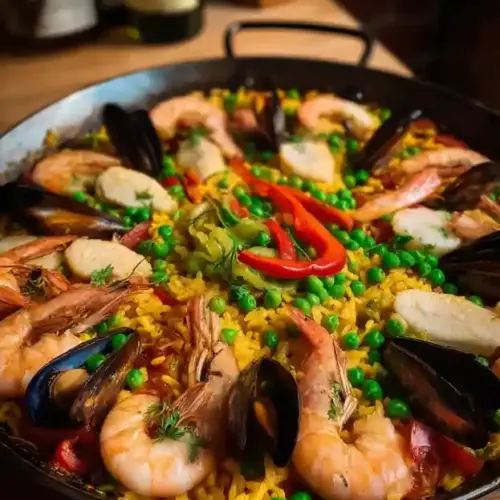
Easy Spanish Paella Recipe
Ingredients
- 2 tbsp olive oil
- 1 onion, finely chopped
- 3 garlic cloves, minced
- 1 red bell pepper, diced
- 1 green bell pepper, diced
- 2 cups Arborio rice
- ½ tsp saffron threads, soaked in 1/4 cup warm water
- 1 tsp smoked paprika
- ½ tsp cayenne pepper
- 4 cups chicken broth
- 1 cup diced tomatoes
- 1 cup frozen peas
- ½ po shrimp, peeled and deveined
- ½ po mussels, cleaned
- ½ po chicken thighs, cut into chunks
- ¼ cup fresh parsley, chopped
- Lemon wedges, for serving
Instructions
- Prepare the Base: Heat olive oil in a large skillet over medium heat. Add onion, garlic, and bell peppers. Sauté until soft and fragrant, about 5 minutes.Toast the Rice: Stir in the rice, saffron with its soaking water, smoked paprika, and cayenne. Cook for 2 minutes, ensuring the rice is well coated.Add Broth and Simmer: Pour in chicken broth and diced tomatoes. Bring to a boil, then reduce heat to low. Cover and simmer for 20 minutes.Incorporate Proteins: Add chicken, shrimp, and mussels. Cover again and cook for an additional 15-20 minutes, until the seafood is cooked through and the chicken is tender.Final Touches: Stir in peas and cook for another 5 minutes. Garnish with fresh parsley and serve with lemon wedges.
Notes
🥗 Free Custom Keto Meal Plan?
Do you want to lose weight while still enjoying delicious Asian & Thai Fusion meals? Take this quick quiz to get your personalized Keto plan based on your favorite foods!
- ✅ No more guessing what to eat
- ✅ Delicious & easy-to-make recipes
- ✅ Tailored to your body type
Get My Custom Plan Now! →
*Over 100,000+ people have transformed their lives with this quiz.